Tartrazine and Tissue Transparency: The Science
Can a food dye make chicken translucent? See what a tartrazine experiment found, how light scattering works, and why the result needs careful interpretation.

Can a Food Dye Make Chicken See-Through? The Physics Behind the Experiment
A piece of raw chicken that looks a little like a gummy bear is not an obvious entry point into optics. But that's what one home experiment set out to test: whether the yellow food dye tartrazine - also known as E102 - could make biological tissue look more transparent.
What the experiment showed was real, but narrow. After soaking, thin pieces of chicken let a grid show through more clearly than an untreated control. They didn't turn into clear glass, and the write-up doesn't pin down exactly what caused the change. Still, the idea behind it is worth talking about: tissue can look opaque not just because it absorbs light, but because its internal structure scatters it in lots of different directions. If you change the optical properties of the fluid around those structures, scattering can drop.
Here's what the home test appeared to show, how the underlying physics is supposed to work, and what you can - and can't - take away from a striking image. One important note up front: this is an optical experiment, not a food-preparation method. Raw chicken left at room temperature for hours is a serious food-safety risk and should not be handled or consumed as food.
What the tartrazine experiment found
This was a small-scale attempt to reproduce part of a 2024 research paper on optical transparency in live animals. The paper, published in Science, tested absorbing molecules - including tartrazine - as a way to make tissue easier to image. The home version was a preliminary test using chicken breast, not a full replication of the paper's method.
In the home experiment, the author made a water control and several tartrazine solutions at different concentrations. Chicken slices were soaked and then examined over a grid and under a light. The most concentrated solution - estimated at about 0.56 M - reportedly crystallized on the sample. The lower concentration - estimated at about 0.19 M - looked more gelatinous and showed some visible translucency. After a later 12-hour soak, the author reported a small difference compared with the water control, especially when the chicken was cut thinner.
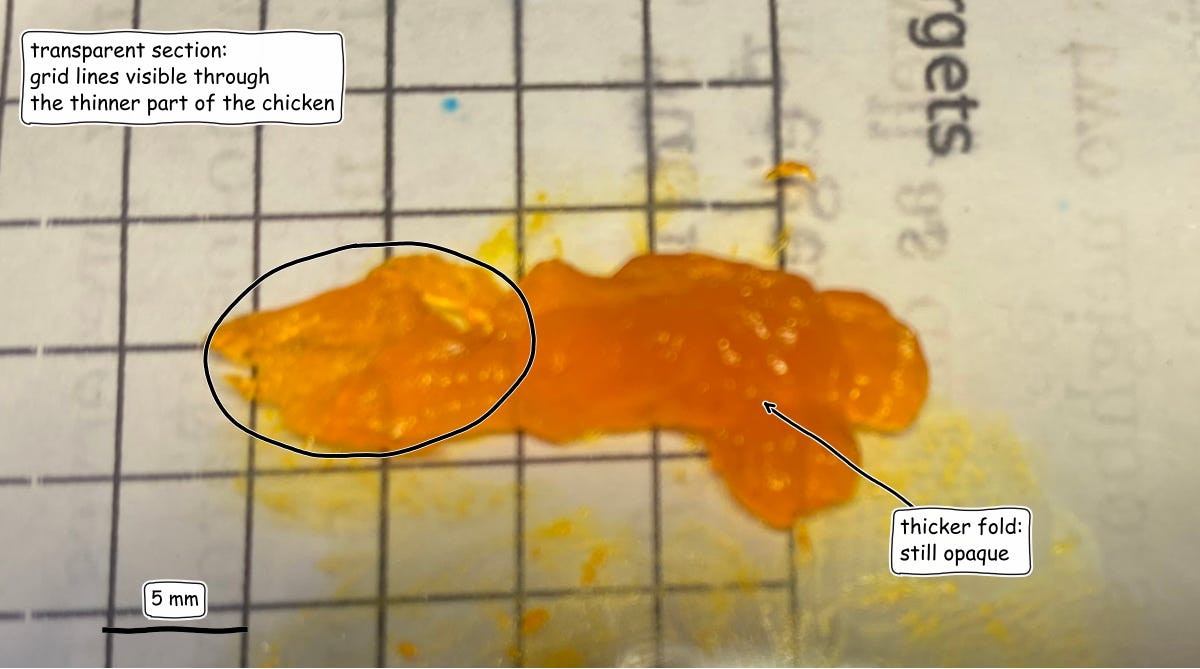
That's an interesting observation, but it isn't the same thing as showing that a whole piece of chicken became transparent. The clearest effect showed up in thin samples, and it was partial. The author described the treated tissue as having a gummy, translucent look, while the control stayed opaque.
The home test also differed from the published protocol in practical ways. The paper used a higher tartrazine concentration, a temperature of 40°C, and a machine shaker. The home experimenter didn't have the equipment to recreate those conditions safely, so they used room-temperature soaks instead. So this reads more like an exploratory demonstration than a controlled replication with matching conditions.
If you're comparing both, read them together: the home experiment and the 2024 research paper. They're related, but they aren't the same question. The paper focuses on optical imaging in living animals; the chicken test asks whether you can see a visual change in a simpler, accessible sample.
Why biological tissue looks opaque
There are two main ways a material can block a clear view: it can absorb light, or it can scatter it. In biological tissue, scattering is often the bigger part of the story.
Absorption removes light
Molecules absorb light at wavelengths where the incoming energy matches allowed transitions inside the molecule. Different molecules absorb different wavelengths, which is why materials have characteristic colors. Tartrazine absorbs strongly around 425 nanometres in the blue-violet part of the visible spectrum. That absorption contributes to its yellow appearance: less blue light is transmitted or reflected back to your eyes.
If a tissue absorbs a lot of the light passing through it, less light reaches the observer or camera - so seeing through it gets harder. But absorption isn't the only reason tissue can look cloudy.
Scattering scrambles the image
Tissue isn't a uniform block. It's made of cells, fibers, proteins, lipids, and fluid. Those ingredients have different refractive indices - the optical property that describes how light travels through a material.
When light crosses boundaries between materials with different refractive indices, its path changes. In tissue, light hits lots of these boundaries. The repeated deflections send rays in many directions, washing out the image behind the sample. A grid can still appear through a thin piece, but the lines lose contrast because light from each point spreads across neighboring areas.
A handy mental model is "small structures in water." Water has a refractive index of about 1.33. Many protein- and lipid-rich structures are closer to 1.45, with some variation depending on the material and conditions. The bigger the mismatch between neighboring regions, the more opportunities there are for light to scatter.
So a material can look opaque even if it doesn't absorb all the light. Light may still pass through - but in a way that's too disordered to preserve a sharp image. Optical clearing methods try to reduce scattering, often by changing the refractive index of the fluid around those structures.
How a dye could change light scattering
The proposed mechanism is that tartrazine alters the refractive index of water inside and around tissue structures. If the surrounding fluid's refractive index gets closer to that of proteins and lipids, the difference at their boundaries shrinks. Less mismatch can mean less scattering, and more light can travel through in a way that preserves contrast.
This explanation leans on something that can sound backwards at first: the wavelengths a molecule absorbs are connected to how it changes how other wavelengths propagate. In optics, the complex refractive index captures both effects. The real part relates to phase velocity and refraction. The imaginary part - often called the extinction coefficient - captures attenuation from absorption.
The link between absorption and refraction isn't unique to tartrazine. In a simplified oscillator picture, electrons in a molecule respond to an oscillating electric field. Their response is strongest at characteristic frequencies that correspond to absorption bands. Even away from a strong absorption peak, the molecule can still shift the real refractive index while absorbing less.
Tartrazine's absorption peak is around 425 nm. For red light (longer wavelength, lower frequency than that peak), a simplified model predicts a positive shift in the real refractive index. In principle, that could help bring the fluid's refractive index closer to protein- and lipid-rich regions without soaking up as much red light as it absorbs near the blue-violet peak.
That's the physical intuition behind the proposal - not a promise. Whether a dye makes a tissue effectively transparent depends on the dye's optical behavior, its concentration, which wavelengths you're imaging, how far it penetrates, and what the tissue is like. A concentration high enough to shift refractive index could also absorb too much light or leave residue at the surface. In the home experiment, the most concentrated solution reportedly crystallized, which is a good example of why "more dye" doesn't automatically mean "more transparency."
And there's another gap between a plausible model and a measured mechanism. The chicken images show a visual difference, but they don't directly measure refractive index, light transmission, or scattering. The explanation is grounded in optical physics and related research, but this demonstration alone can't isolate the cause of the observed translucency.
What the result does - and does not - show
The strongest conclusion from the home write-up is limited and specific: under the reported conditions, thin chicken samples soaked in a tartrazine solution looked more translucent than water-soaked controls. The grid was visible through parts of the treated sample, while the control stayed more opaque. The effect appeared subtle in some images and clearer in the thinnest slices.
That matters for a simple reason: a small demo can make an abstract optical effect easier to see. It also raises a broader question - whether accessible optical tricks can help people inspect biological structures without expensive imaging equipment. But this particular experiment doesn't answer that question on its own.
Limits of the demonstration
A few things make it hard to compare the result in a quantitative way:
- Sample thickness matters. A 2 mm slice transmits more light than a thicker piece, even before treatment. Small thickness differences can change what looks like "transparency."
- The comparison was visual. The report doesn't include measured transmission, a standardized light source, or image analysis that quantifies contrast versus the control.
- The conditions differed from the paper. The home attempt used room temperature and no shaker, rather than reproducing the published conditions.
- Tartrazine purity was uncertain. The powder was listed as more than 80% dye content, so the actual concentration could have been lower than the nominal estimate.
- Surface residue may affect appearance. The highest-concentration sample reportedly turned crusty as tartrazine crystallized. That doesn't tell you how evenly the dye diffused through tissue.
These caveats don't erase the observation. They define what it can support: an exploratory result that could motivate a more controlled test, not a proven, general-purpose transparency method.
Food safety is not optional
These samples were raw chicken, and the report describes soaking them at room temperature, including a 12-hour soak. That isn't a safe food-handling practice. Raw poultry can carry bacteria such as Salmonella and Campylobacter. Covering a sample or putting it in a test tube doesn't make it safe, and adding a food-grade dye does not disinfect it.
Do not eat treated chicken, and don't treat this like a recipe. If you're doing biological or optical experiments, use appropriate lab practices, dedicated equipment, protective measures, and safe disposal. Follow local food-safety guidance and any institutional rules. Just because a substance is allowed as a food additive doesn't mean every experimental exposure is risk-free.
Overall, this is best understood as a visual science demonstration written up by the author - not as a validated home protocol or a substitute for the controlled methods used in research.